
ARTICLE
Ergonomics Means Knowing How to Paddle Upstream
Foreword
It is possible to overlook (or choose to overlook) the benefits of ergonomics. However, it is impossible not to notice the consequences of poor ergonomics.
This is the paradox of how ergonomists are perceived within organizations. Ergonomists can contribute significantly to the organizations that hire them, yet they are often brought in under mandates that severely limit what they can accomplish.
So, how can organizations get the most out of an ergonomist?
The simple answer is to understand what ergonomists can do, develop the mandate with them, and involve them at the right time.
This five minute read will help you better define (or redefine) the ergonomist’s role and understand how they can support what matters most to your organization.
“What does an ergonomist do?”
This is a question I like to ask at the beginning of every training session I deliver to workplace teams.
Often, the perception of the ergonomist is limited to that of the “posture police” an expert in proper workplace posture. At other times, I am pleasantly surprised to hear a more nuanced definition that positions the ergonomist as a professional who transforms work to better support workers.
In every case, however, the same pattern emerges: the ergonomist is called in because a need has already been identified downstream.
The reality of consulting in private organizations is that ergonomists are still too often brought in after the most important decisions have already been made.
In a study of 64 engineers from five Swedish manufacturing companies, Falck and Rosenqvist¹ found that ergonomic measures were often introduced too late, after complaints had emerged or health problems were already present. The authors also noted that engineers sometimes had a limited understanding of the ergonomic consequences of their design decisions.
The product has already been designed, the equipment purchased, the contract signed, the production rate established, and the workspace built. At that point, the only remaining option is often to try to adapt the worker to a system whose main constraints have already been fixed.
The ergonomist is asked to transform the work, but only after the most influential decisions have already been made.
Have you ever been on a river where the current flows against your intended direction? It can be frightening. You struggle, expend energy, and eventually become exhausted … only to remain in the same place.
You can adjust your paddle, improve the kayak seat, or learn to distribute your effort more effectively. You may even be able to remove a few rocks from the river. However, you often have very little influence over the river’s path, flow, or current.
The ergonomist should not intervene solely to make a demanding workstation temporarily more tolerable.
Their role should also be to understand why the situation exists, which decisions created it, and what transformations could prevent it from recurring.
To do that, they must paddle upstream.
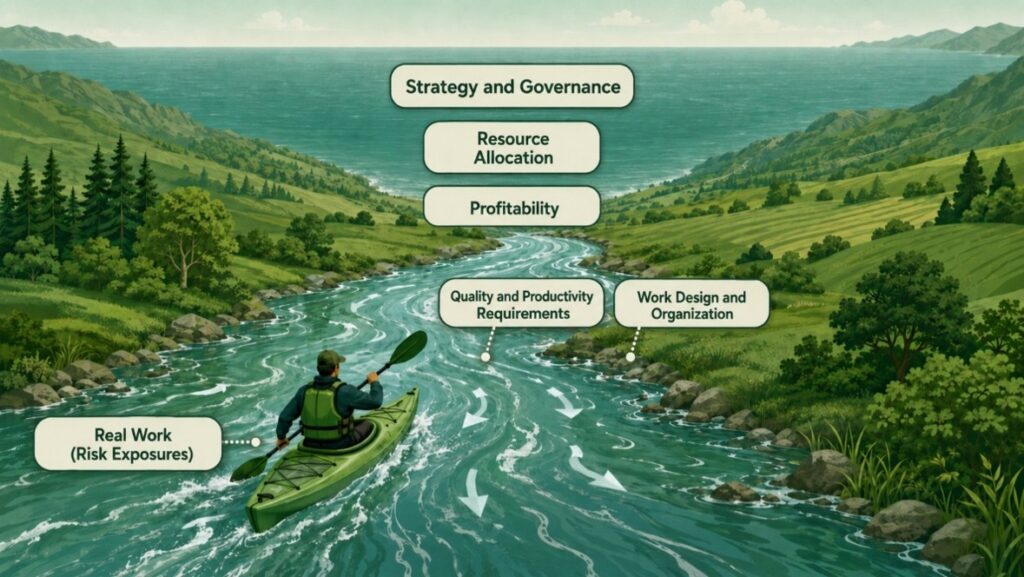
Key takeaway: If you want to get the most out of an ergonomist, allow them toexamine the workstations and operations both before and after the targeted position. Give them the opportunity to question the design, work organization, and quality and productivity requirements. Only by thoroughly analyzing all the factors influencing risk at the targeted workstation can the work be meaningfully transformed and lasting benefits achieved.
From the Workstation to the Business Model: How Far Upstream Should the Ergonomist Go?
A systematic review² of 73 empirical studies conducted in manufacturing environments identified numerous relationships between product, process, and workstation design on the one hand, and production quality on the other. The authors concluded that human factors are not peripheral to quality, they are among its key determinants.
Consider a physically demanding material-handling task. The ergonomist may initially observe that loads are handled far from the body, movements are performed quickly, or the shoulders are repeatedly elevated. However, they may also examine the operational consequences of these conditions:
- How many products are dropped or damaged?
- How much time is lost retrieving a box or repositioning a load?
- Does fatigue cause workers to slow down as the shift progresses?
- Have experienced workers developed strategies that are absent from the official work method?
- Do new employees have greater difficulty meeting production targets?
- Does this workstation generate more absences, employee turnover, or training needs?
The kayaker’s effort is therefore not merely a health issue. It also reveals design limitations and weaknesses within the production system.
Productivity should not be reduced to the number of units produced per hour. It should also reflect the organization’s ability to maintain reliable production without increasing defects, stoppages, fatigue, and resource consumption. These losses, along with absenteeism and employee turnover, can quickly offset the gains associated with a faster production rate.
Working conditions, quality, productivity, and profitability are closely interconnected. They can either strengthen or weaken one another.
This relationship also works in the opposite direction. Cohn and Wardlaw³ found that occupational injury rates increased as corporate debt rose and following negative cash-flow shocks, while injury rates decreased following positive cash-flow shocks.
Under financial pressure, workplace safety and preventive ergonomic measures may therefore be among the first expenses to be postponed.
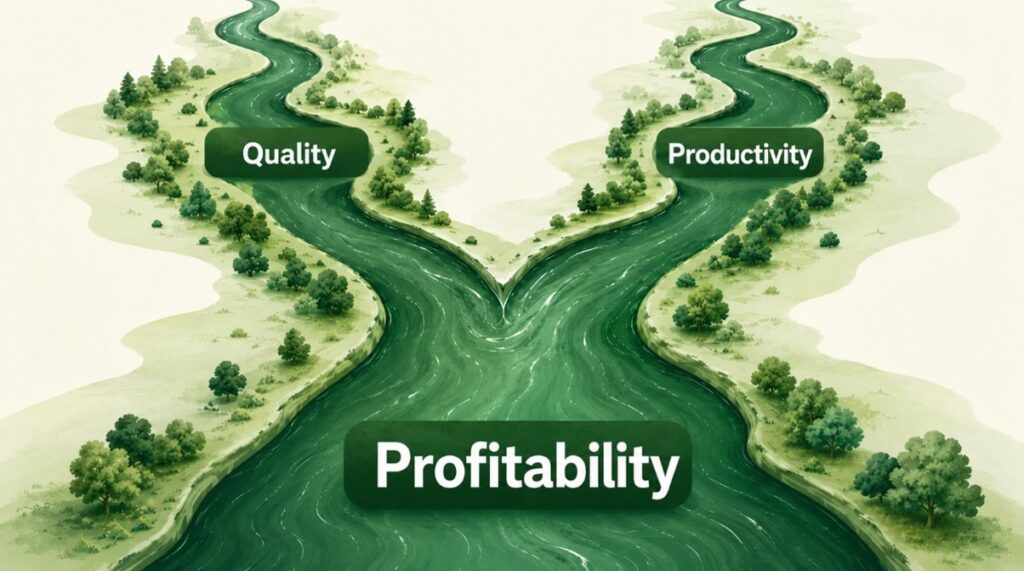
Key takeaway: If you want to get the most out of an ergonomist, give them access to the relevant data collected by your organization, such as injury rates, absenteeism, production downtime, and employee turnover at the workstation. This makes it possible to translate ergonomics into financial value and improve the likelihood of achieving a positive return on future preventive investments, or, at the very least, to provide a clearer picture of the economic consequences of inaction.
Toward a Better Understanding of the Ergonomist’s Role
As long as ergonomics is viewed solely as an intervention intended to temporarily reduce risk at a particular workstation, it will often continue to be perceived as a peripheral cost. Ergonomists will be brought in too late, after the equipment has been purchased, objectives established, and budgets allocated.
By connecting their findings to quality, productivity, and profitability, ergonomists make their contribution relevant to a broader range of stakeholders, including operations, engineering, human resources, finance, and senior management.
Dul and Neumann⁴ specifically proposed positioning ergonomics as a contributor to organizational strategy and overall system design, rather than as a late-stage response to health problems. Ergonomics can simultaneously support worker well- being, quality, flexibility, productivity, and cost control.
This broader understanding can also promote a more beneficial allocation of available resources. Savings generated by reducing defects, stoppages, absenteeism, or employee turnover can be reinvested in equipment, training, staffing, and greater operational flexibility.
This can create a more virtuous cycle.
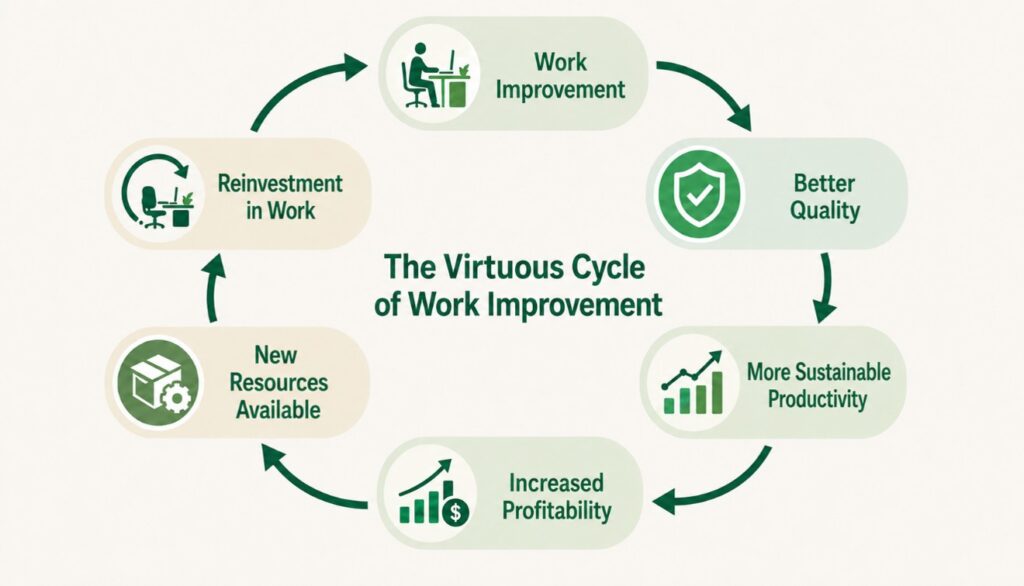
However, such reinvestment is never automatic
It depends on governance decisions. Part of the ergonomist’s broader role is to make the benefits of reinvestment visible and contribute to the discussions in which these decisions are made.
Key takeaway: If you want to get the most out of an ergonomist, allow them to present their findings and discuss preventive measures at the executive level. At the very least, use their expertise to support the discussions and negotiations that must take place with your organization’s leadership.
Without investment, work cannot be transformed sustainably. It is therefore essential to identify the investments that will provide the greatest overall benefit to the organization. The ergonomist is particularly well positioned to guide this analysis in a way that creates value for everyone involved.
Conclusion
This is not an easy journey. The ergonomist must continue to support the worker (the kayaker) who, in some organizations, is constantly paddling against the current. They must analyze the worker’s efforts, understand their strategies, and reduce the obstacles threatening their health today.
However, the ergonomist cannot always stop at that section of the river.
They must also paddle upstream: beginning with the observed risk exposures, revealing how they are connected to quality, productivity, and profitability, and ultimately reaching the design, organizational, and governance decisions that determine the direction of the entire system.
– Hamza Azzouzi, ergonomist EA
Bibliography
- Falck, A.-C., & Rosenqvist, M. (2012). What are the obstacles and needs of proactive
ergonomics measures at early product development stages? An interview study in five
Swedish companies. International Journal of Industrial Ergonomics, 42(5), 406–415. https://doi.org/10.1016/j.ergon.2012.05.002 - Ahmet Kolus, Richard Wells, Patrick Neumann, Production quality and human factors
engineering: A systematic review and theoretical framework, Applied Ergonomics, Volume
73, 2018, Pages 55-89, ISSN 0003-6870, https://doi.org/10.1016/j.apergo.2018.05.010. - COHN, J.B. and WARDLAW, M.I. (2016), Financing Constraints and Workplace Safety.
The Journal of Finance, 71: 2017-2058. https://doi.org/10.1111/jofi.12430 - Jan Dul, W. Patrick Neumann, Ergonomics contributions to company strategies, Applied Ergonomics, Volume 40, Issue 4, 2009, Pages 745-752, ISSN 0003-6870, https://doi.org/10.1016/j.apergo.2008.07.001.