
ARTICLE
How to Get the Most Out of an Ergonomist’s Mandate
Foreword
The benefits of ergonomics can be overlooked (or deliberately ignored). The consequences of poor ergonomics, however, are impossible to miss.
This is the paradox of the ergonomist’s role within an organization. Ergonomists can help address several issues that are critical to organizational performance, yet they are often brought in too late and given such a narrow mandate that they can only address a small part of the problem.
So, how can you make better use of their expertise?
Consider a workstation where employees repeatedly handle boxes. Shoulder and back pain are increasing, absences are becoming more frequent, and the position is increasingly difficult to fill. A mandate limited to “assessing working postures” will certainly help document the physical demands and identify a few possible adjustments. However, it may leave the root causes of the problem untouched.
By examining the operations before and after the workstation, the ergonomist may discover that boxes arrive irregularly, creating periods of accumulation; that the workstation layout forces workers to twist; and that productivity requirements leave little opportunity for recovery. The solution is therefore no longer limited to improving the worker’s posture. It may involve changing the product packaging, reorganizing the workflow, redistributing the work, or mechanizing certain tasks.
This is when the ergonomist needs an ally within your organization.
That ally is you. Yes. The person who commissioned the ergonomic assessment.
It is simple and convenient to organize the site visit and wait for the final report. However, if you want the intervention to go further, you must give ergonomist access to the information needed to determine the true value of the proposed preventive measures.
In our example, the ergonomist might recommend redesigning the workstation, regulating the arrival of boxes, introducing a lift table, or mechanizing part of the handling process. To compare these solutions and demonstrate their relevance, however, the ergonomist must understand the current consequences of the
problem.
- How many absences are associated with this workstation?
- What does it cost to replace absent employees?
- What is the turnover rate?
- How long does it take to recruit and train a new employee?
- Do box accumulations lead to production stoppages?
- How many products are dropped, damaged, or require rework?
This information may come from occupational health and safety, humanresources, production, quality, or finance. When examined separately, these data describe different operational challenges. When brought together through an analysis of the work, they reveal the true cost of the current situation.
This provides a clearer picture of both the potential return on investment of the proposed solutions and the economic consequences of doing nothing.
Access to data, however, is not enough. The analysis must also reach the people who have the authority and resources to act.
As the project sponsor, you must identify and involve the relevant stakeholders, including those responsible for:
- Operations;
- Engineering;
- Maintenance;
- Finance; and
- Human resources.
Depending on the scope of the proposed solution, it may also be necessary to involve a senior manager who can influence budget priorities and organizational governance.
The objective is never simply to “sell” a recommendation. It is to create the conditions for that recommendation to be understood, discussed, adapted, and evaluated at its true value.
To maximize the impact of an ergonomic intervention, the ergonomist needs an ally who can bridge the gap between the analysis of real work and the people who control the resources required to transform it. Without that ally, even an excellent recommendation may remain buried in a report. With the right support, the ergonomist can become a genuine driver of organizational transformation.
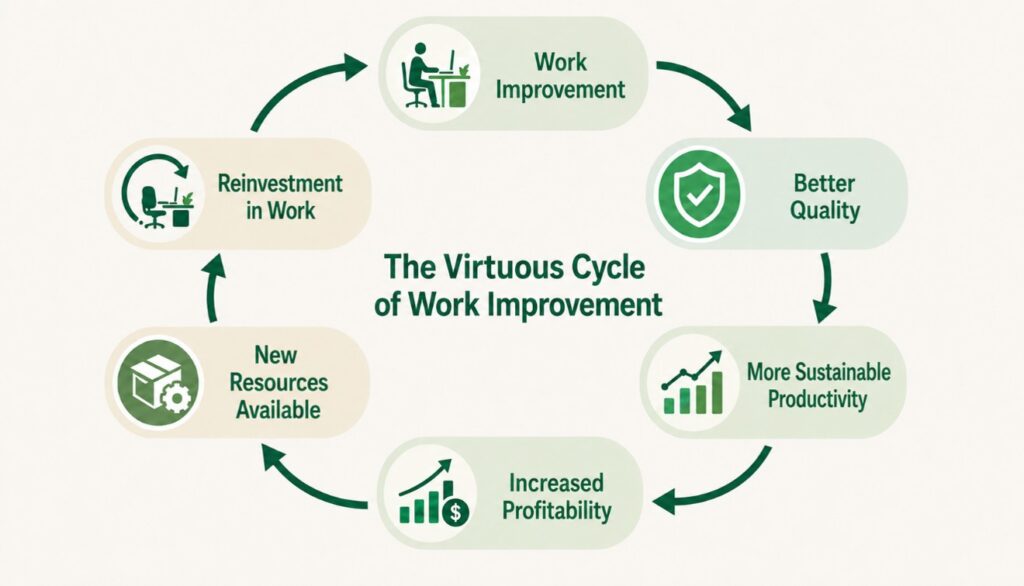
In short, to get the most out of an ergonomist:
- Allow them to look beyond the targeted workstation and understand what happens before and after it.
- Give them access to relevant data, including injuries, absences, employee turnover, and production stoppages, so they can assess the cost of the problem and the potential benefits of the proposed solutions.
- Invite them to present their findings to managers and decision-makers so that recommendations are more likely to be translated into action.
– Hamza Azzouzi, ergonomist EA