
Industrial ergonomics :
safety and performance in an industrial context
Ergonomic recommendations adapted to your workstations, tools and work methods
The process can begin with an ergonomic diagnosis to identify high priority workstations requiring interventions.
Once the priorities have been identified during an ergonomic study, an ergonomist analyses the tasks, the workstation, the work environment, the tools and the production process.
Based on these findings, we collaborate to design appropriate solutions and support you until they are implemented.
In today’s highly competitive and constantly changing world, the ergonomist is an indispensable ally in ensuring health and safety while maximizing your teams’ productivity.
Whether in a factory, distribution center, assembly shop or construction site, you can benefit from our recognized expertise to optimize your industrial spaces and processes while ensuring the health and safety of your teams.
Which Level of Ergonomic Assessment Is Right for You?
Ergonomic needs vary depending on the organization and the work situations involved. Some organizations want to gain an overall picture of ergonomic risks and establish their priorities, while others need to better understand risk factors or develop specific solutions.
To address these different needs, Ergokinox offers three levels of ergonomic assessment:
- An Ergonomic Risk Profile helps identify, assess and prioritize work situations requiring attention.
- An Ergonomic Diagnostic Assessment provides a more detailed analysis of risk factors and their underlying determinants to identify the main improvement objectives and potential courses of action.
- An In-Depth Ergonomic Assessment provides a thorough analysis of a work situation to develop specific, practical recommendations, along with an action plan when appropriate.
These services are complementary but do not necessarily need to be completed sequentially. The Risk Profile identifies where to act, the Diagnostic Assessment determines what to address, and the In-Depth Assessment defines how to act.
Ergonomic study
Once a priority has been identified, it's time to turn to the ergonomic study of a specific workstation or task.
An ergonomic study is a structured intervention designed to identify ergonomic risk factors and their determinants (causes). The analysis compares the identified risks with established norms to measure exposure and establish intervention priorities. Its success is based on a structured, participatory approach that includes:
✔ Proposing solutions tailored to and developed in collaboration with the organization: By considering the specific realities and needs of the company with their involved stakeholders, we ensure the recommendations’ feasibility and acceptability.
✔ Presentation of recommendations based on a cost/benefit matrix: Each solution is evaluated according to its impact on worker’s health, productivity and implementation costs, enabling informed and strategic decision-making.
✔ Support during the implementation of the recommendations to ensure their effectiveness: A follow-up is carried out to ensure that the adjustments are properly integrated and are delivering the expected benefits. Additional adjustments will be made if needed to maximize results.
01
Start
02
Observation
03
IDENTIFICATION AND PRIORITIZATION
04
RESEARCH AND SOLUTIONS
05
ESTABLISHMENT
06
FOLLOW-UP
Are you hesitating between obtaining a diagnosis or commissioning a study?
Our team will be happy to provide you with advices and an expertise to demystify what would be most relevant to your business.
Artificial intelligence (AI) in ergonomics
Our advanced risk analysis solution
This innovative technology guarantees an objective data collection, guiding you towards more personalized solutions.
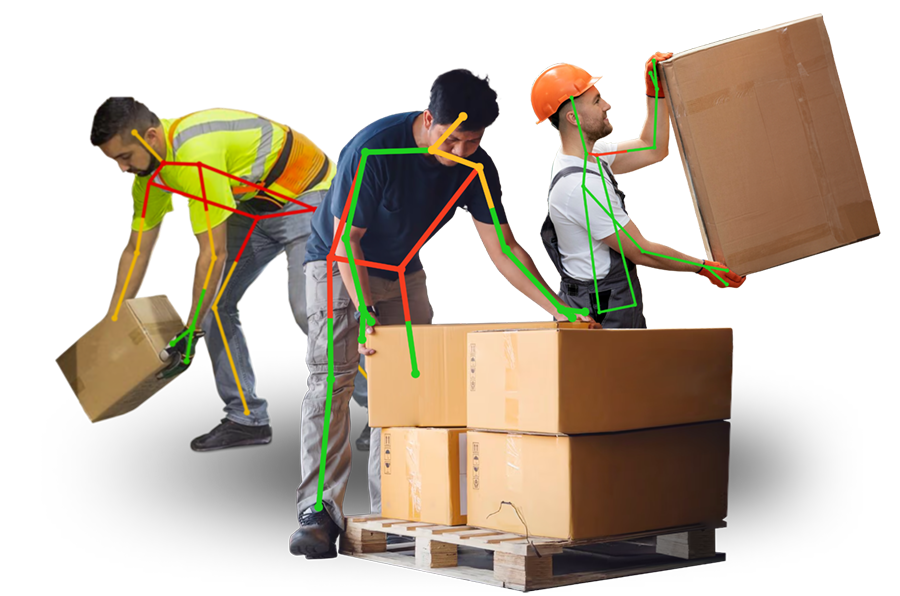
Powered by Inseer.
Train to better manage ergonomic risks
Take charge of ergonomics-related issues in your organization by using our training matrix. Designed and adapted to meet your specific needs in various industries, our training courses cover the identification, prioritization and control of ergonomic risks.
You think about implanting exoskeletons ?
An innovative solution to reduce MSD risk in the workplace.
Exoskeletons are gaining in popularity and generating interest as a means of reducing the risk of MSDs and, potentially, improving productivity. However, their success depends on a key factor that is all too often overlooked: proper evaluation and, above all, a planned integration.
Ergokinox ergonomists have the expertise to support you in evaluating this solution.
Explorez ces outils pratiques en ligne sur l’ergonomie industrielle
Explore these practical online tools for industrial ergonomics
Handling in the workplace - IRSST Website
CONSULT / VISIT THE WEBSITE ((French version)
Practical guide to ergonomics in 128 points – ILO document (in collaboration with IRSST)
CONSULT THE DOCUMENT (FRENCH VERSION)